
# How Hardwood Refinishing Works on Long Island Homes
Three out of every five homes we walk into on Long Island already have oak hardwood — they just don't know it. It's buried under 1980s carpet, covered by mid-'90s tile, or just worn down past the finish and looking tired. The right call in most of those cases isn't replacement. It's refinishing.
This guide explains exactly what happens when we refinish a floor — start to finish — so you know what you're paying for and what to expect during the week we're in your house.
## When refinishing makes sense
Refinish if:
- Original hardwood has at least 3/16" of wear layer left above the tongue
- Boards are flat, not cupped or crowned (moisture has to be fixed first)
- Fewer than 10% of boards need replacement
- You're okay with the existing plank width and species
Replace if:
- Wear layer is gone (you can see nail heads or tongue-and-groove joints)
- More than 10–15% of boards are water-damaged, split, or missing
- You want a different plank width, species, or pattern
- The floor is engineered hardwood with less than 3mm of wear veneer
About 60% of the "I need new floors" calls we get turn into refinish jobs once we inspect. It's usually $4–6/sq ft versus $12–16/sq ft to replace. Nice surprise for the homeowner.
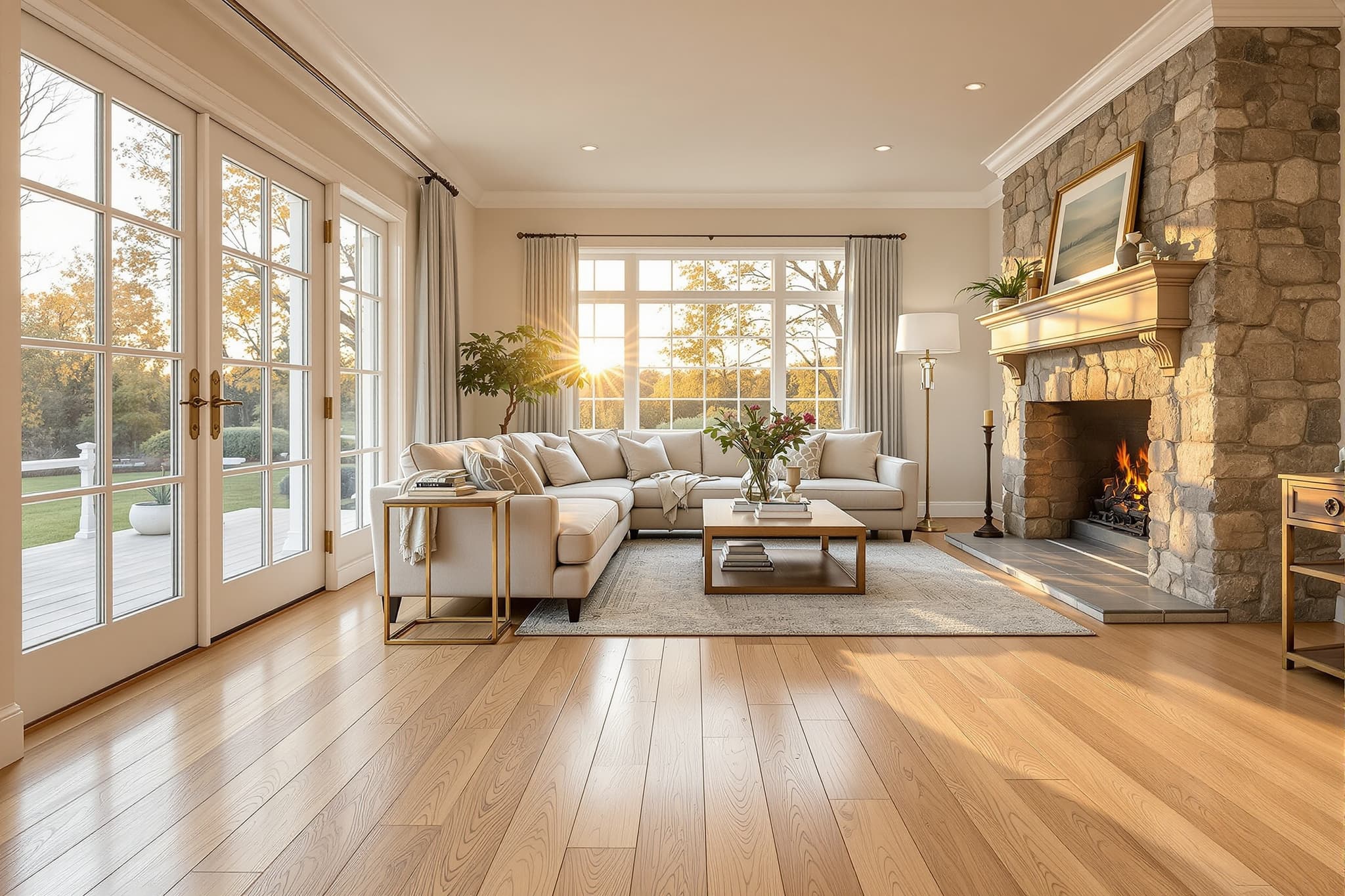
## The process, step by step
Total timeline: typically 4–6 working days for 1,000–1,500 sq ft, plus a cure-out window before full furniture return.
Day 1 — Prep and demo
We move furniture (or you do, depending on the quote). We remove base shoe (the quarter-round at the floor edge) — not the baseboards themselves, unless you're painting. We protect wall outlets, HVAC registers, and adjacent rooms with plastic.
If any boards need replacement, we do it now. Face-nailing and gluing new boards into the existing pattern is a craft. A good installer matches grain and color close enough that the patches disappear under stain.
Day 2 — Rough sand
We start with coarse grit (36 or 40) on a large belt sander to cut through old finish and level the floor. This is the dustiest, loudest step. Modern dustless sanders (we use Bona Atomic) capture 95%+ of dust at the source, vented outside through a 4" hose. You'll still see some dust; anyone who says "zero dust" is lying.
Corners and edges that the belt sander can't reach get cut with an edger — a smaller spinning disc sander. This is the slowest part of the job, and it's where the skill shows. A sloppy edge job leaves drum marks visible forever.
Day 3 — Fine sand and prep
We step the belt sander through finer grits — 60, 80, sometimes 100. Each pass removes the scratches from the prior grit. Then we hand-scrape any stubborn corners, buff the entire floor with a planetary polisher, and vacuum with HEPA filters.
This is when we check for any nails sitting proud, loose boards, or gaps that need filling. We fill small gaps with a wood-tone latex filler; larger gaps we leave or board-replace.
Day 4 — Stain (optional)
If you're changing the color, we apply water-popped stain. Water-popping means we mist the floor with water before staining, which opens the grain and accepts color more evenly. Skipping water-pop is a shortcut that causes blotchy stain — we never skip it.
Stain dries 4–24 hours depending on type and humidity. Summer in Long Island is slow due to humidity; in January we can often stain morning and topcoat the same evening.
If you're keeping the natural wood color (just renewing the finish), we skip this step.
Day 5 — First finish coat
We apply the first coat of finish. Your options:
- Waterborne polyurethane (Bona Traffic HD, Loba Easy) — clear, fast-drying, low-odor, light ambering. Our default for most jobs.
- Oil-modified polyurethane (Dura Seal, Duraseal Quick Dry) — ambers over time, slower dry, stronger odor, slightly warmer look. Good for traditional homes.
- Hardwax oil (Rubio Monocoat, Pallmann Magic Oil) — penetrates instead of films, very matte, easy spot-repairs, requires owner maintenance every 1–2 years.
First coat dries 2–6 hours, then we screen-sand (lightly abrade) to de-nib any raised grain.
Day 6 — Second and third coats
Two more topcoats, with a screen-sand between if needed. Industry standard is 3 coats total for residential traffic; commercial jobs sometimes get 4.
Cure-out window
This is the part homeowners hate: the floor is dry to the touch in 4–6 hours, but not fully cured for 3–7 days depending on finish type. During that window:
- Day 1: Walk in stocking feet only. No furniture, no pets.
- Days 2–3: Light furniture can return (with felt pads). Area rugs stay off.
- Day 7+: Full use. Area rugs can go back. Floor is at full hardness.
We plan the schedule around that cure-out. Most homeowners vacate the sanding-and-finish days (usually 2–3 nights in a hotel or with family) and return to the cure phase.
## Cost breakdown
Typical Long Island 2026 refinishing costs, installed:
| Scope | Per sq ft | Notes |
|---|---|---|
| Sand + 3 coats waterborne, natural | $3.50–4.50 | Most common job |
| Sand + stain + 3 coats | $4.50–5.75 | Color change |
| Heavy prep + board replacements | $5.50–7.00 | 5–10% board replacement |
| Hardwax oil finish upgrade | +$1.50 | Adds per sq ft to above |
| Moving furniture (per room) | $75–150 | If we do it |
| Baseboard paint | $2–3 | If we handle it |
For a typical 1,200 sq ft project with stain, plan $5,400–6,900.
## Dust and smell management
Two questions every homeowner asks. Honest answers:
Dust: With a dustless sander setup, 95%+ is captured. You'll still find fine dust on shelves and upper surfaces for a week after — it's just physics. We plastic-seal adjacent rooms and run HEPA air scrubbers during the sanding days.
Smell: Waterborne finish has minimal odor (mild, dissipates in hours). Oil-based finish smells strongly for 24–48 hours; most families vacate during finish days. Hardwax oils fall in between.
## When to refinish vs. when to buff-and-coat
Quick distinction:
- Full refinish (what we described above): sand to bare wood. Required when the finish is worn through in traffic areas, or when changing color.
- Buff-and-coat (aka "screen and recoat"): just abrade the existing finish and add one fresh topcoat. $1.50–2.50/sq ft. Works if the current finish is intact but dull, with no deep scratches, no color change. Takes 1 day.
Buff-and-coat every 5–7 years can delay a full refinish by decades. A lot of Long Island homeowners don't know this is an option — we mention it often.
## Free inspection
Not sure what your floor needs? We'll come look. If it can be refinished, we'll tell you. If you're better off replacing, we'll tell you that too — and we won't try to sell you on the more expensive option.