
# High-End Flooring for Long Island Homes, Material by Material
"High-end" gets put on a lot of flooring that isn't. A glossy showroom sample and a big price tag don't make a floor last.
What actually separates a premium floor from a mid-range one comes down to four things. The material itself, how much of it can wear before you hit the core, how it is installed, and the prep work underneath that nobody sees.
This guide walks through the options people ask about when the budget has some room in it. For each one, it covers where it makes sense in a Long Island house and what to watch for.
What makes a floor high-end
Before looking at specific materials, here is what to check on any floor that is sold as premium:
- A real material on top. Real wood, real stone or porcelain all the way through, not a printed image.
- A thick wear layer. On engineered wood, the sawn top layer decides how many times the floor can be sanded in the future.
- Stability for the size. Wide boards and large tiles need a product and a subfloor built to stay flat.
- Detail at the edges. Clean transitions between rooms, matched stair nosings and thresholds, and a pattern that lands evenly at the walls.
- A finish you can live with. Matte and satin hide wear; gloss shows every scratch.
If a floor is expensive but misses on these, you are paying for the label.
Wide-plank European oak
European oak is a white oak species grown in Europe. Most of what is sold as wide-plank European oak is engineered, with a sawn oak top layer on a plywood or multi-ply core.
That construction is the point, not a shortcut. Solid boards seven inches wide and up move a lot between humid Long Island summers and dry, heated winters. An engineered board with a good core stays much flatter, and it can go over a concrete slab or radiant heat where solid wood can't.
European oak usually comes in grades from clean select to knotty rustic, and in matte, brushed or oiled finishes. Oiled floors have a soft, natural look and can be spot-repaired, but they need re-oiling now and then. Factory lacquered or urethane finishes ask for less upkeep.
Ask about the thickness of the top layer, not just the color. A thicker wear layer means the floor can be sanded and refinished years from now instead of replaced. Our page on European oak flooring covers solid versus engineered and how each one goes down.
Herringbone and chevron
Pattern floors are the clearest sign of a high-end install, because they are mostly labor.
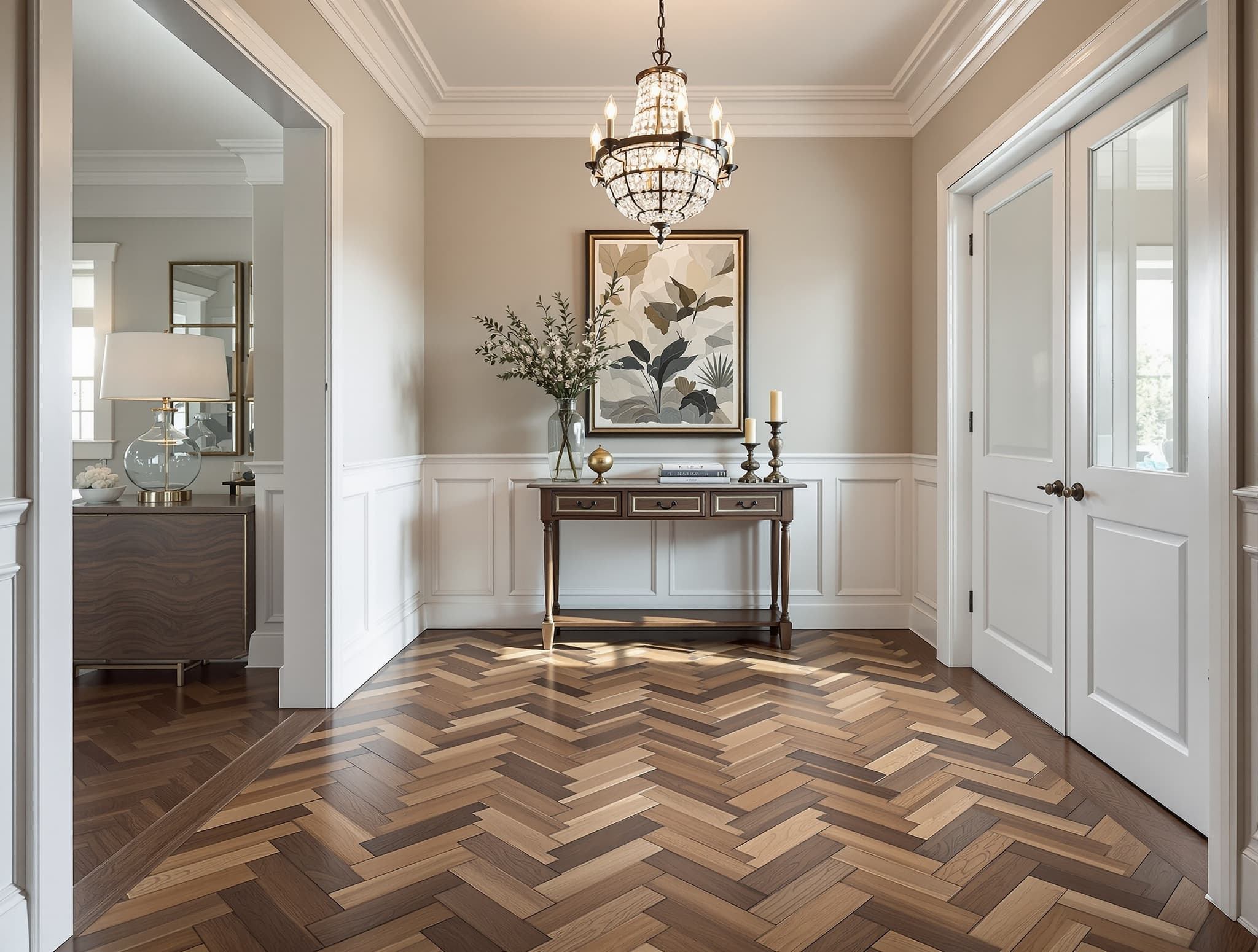
Herringbone uses rectangular boards laid in a staggered zigzag. Chevron boards are cut at an angle on the ends so they meet in a clean point down the middle of each row. From across the room they look similar, but chevron reads more formal.
Both take more layout time and more material than a straight lay, because every row ends in a cut. Both look best when the room is laid out from a center line so the pattern lands evenly at the walls. A border of straight boards around the edge of the room is a common way to frame the pattern and handle out-of-square walls.
Entry halls, dining rooms and living rooms are where these patterns get used most. See herringbone and chevron hardwood floors for how the layout and install work.
Site-finished solid hardwood
Most hardwood today comes prefinished from the factory. It goes in faster, there is no sanding dust in the house, and the finish is very tough.
Site-finished hardwood is raw wood that gets installed, sanded flat and then stained and finished in place. It takes longer and you are out of the rooms for a few days, but it gives you two things prefinished can't:
- Any color you want. Stain is mixed and tested on your floor, under your light.
- A dead-flat surface. No small bevels between boards for dirt to collect in.
It is also how you match new wood to an existing floor. The old and new floors are sanded and finished together, so the color carries through. The same sanding and finishing process is used in hardwood refinishing, which is worth pricing first if the floor you have is sound.
Large-format porcelain and natural stone
Tile has its own high end. Large-format porcelain, 24 by 48 inches and bigger, gives a calm floor with very few grout lines.
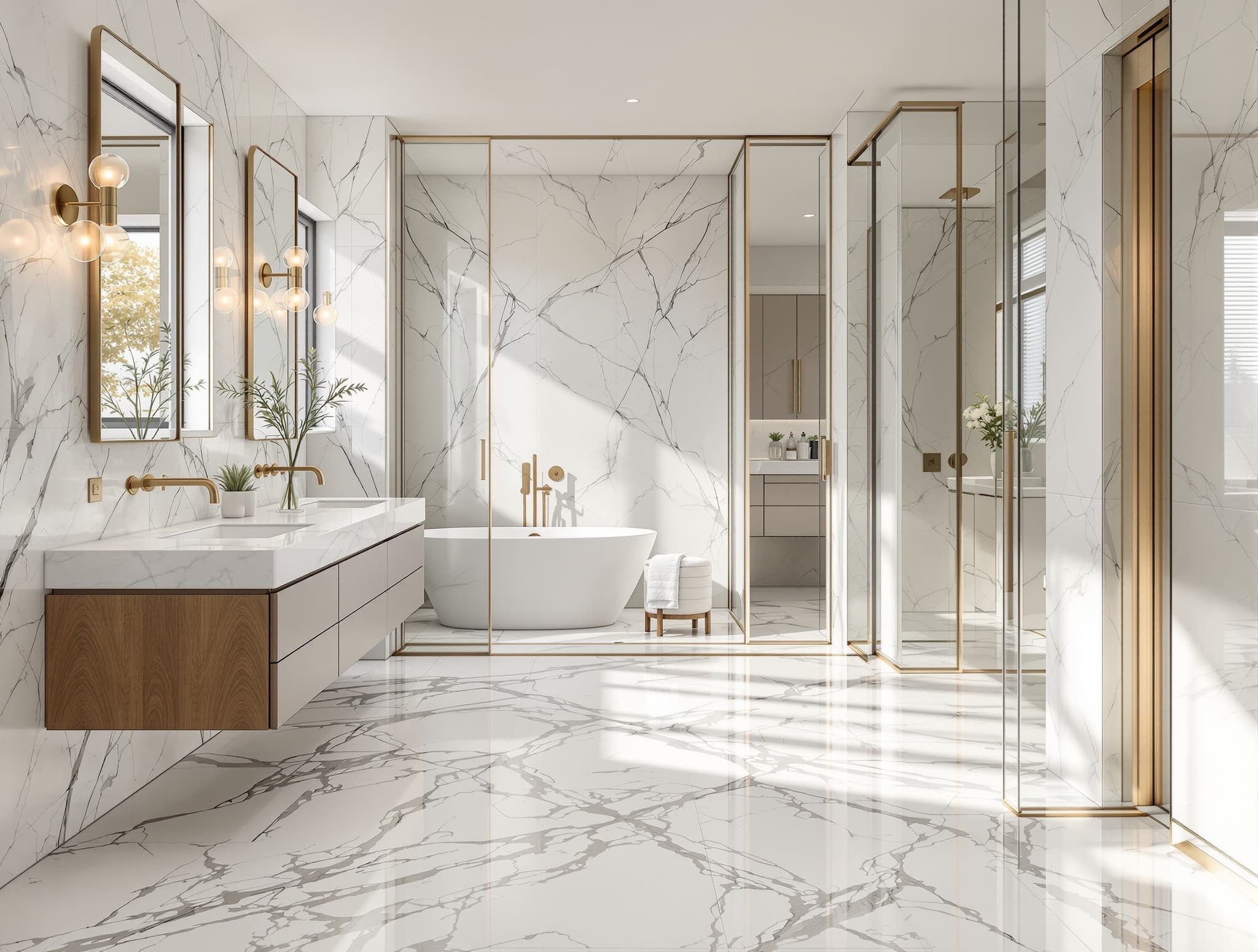
Big tiles are unforgiving. The floor under them has to be flat and stiff, or the edges of neighboring tiles sit at different heights. That is why large-format work usually includes leveling the subfloor and using a leveling clip system during the set.
Real marble is beautiful in foyers and baths, but it is softer than porcelain. It scratches, it etches from acidic spills like lemon juice or wine, and it needs sealing. In a kitchen, a marble-look porcelain gives you the look without the upkeep. For the install itself, see porcelain tile installation.
Where premium LVP fits
Even in a house with oak and stone upstairs, some rooms are wrong for both. Basements, mudrooms and laundry rooms see water, grit and temperature swings.
A good rigid-core luxury vinyl plank with a thick wear layer is the right material there. It is waterproof, it floats over a slab, and the better products look convincing. Our LVP flooring page covers what separates a good plank from a cheap one.
High-end flooring options compared
| Option | Best rooms | What to watch for |
|---|---|---|
| Wide-plank European oak (engineered) | Living areas, bedrooms, over slab or radiant heat | Wear layer thickness; oiled finishes need re-oiling |
| Herringbone or chevron hardwood | Foyers, dining rooms, living rooms | More labor and material waste; layout from a center line |
| Site-finished solid hardwood | Main floors over plywood; matching existing wood | Several days out of the rooms; dust and drying time |
| Large-format porcelain | Kitchens, baths, mudrooms, foyers | Needs a flat, stiff subfloor; lippage on big tiles |
| Natural marble or stone | Foyers, baths | Scratches and etching; needs sealing |
| Premium rigid-core LVP | Basements, laundry, mudrooms, rentals | Wear layer and core quality vary a lot by product |
The prep is what you are really paying for
On any premium floor, the part that decides how it looks in five years is the work underneath.
- Flatness. Wide boards and large tiles show every hump and dip, so the subfloor gets checked and leveled first.
- Moisture. Wood and slabs get tested before anything goes down, especially below grade.
- Acclimation. Wood needs time in the house with the heat or air running before it is installed.
- Radiant heat. Only certain engineered products and tile are rated for it, and the system has to be run correctly before and after the install.
- Transitions and stairs. Matching thresholds, reducers and stair nosings is what makes a floor look finished.
A quote that skips these steps is not a high-end quote, whatever the material costs.
How Long Island houses change the choice
Where your house sits matters as much as what you like.
Near the water on the South Shore or along the North Shore harbors, humidity swings are bigger, and engineered wood holds up better than solid. Homes on slab, common in post-war developments and in raised or rebuilt houses near the bays, need engineered wood, tile or LVP rather than nail-down solid.
Older homes on the North Shore, in places like Setauket and Huntington, often have wide boards or original oak worth saving. There, the high-end move may be refinishing what you have and adding a matched pattern in the entry, not tearing everything out. Our guide to flooring in Suffolk County goes town by town.
Frequently asked questions
Is engineered hardwood less high-end than solid?
No. For wide planks, floors over concrete and floors over radiant heat, engineered is the better product. What matters is the thickness of the top layer and the quality of the core. A thick-wear-layer engineered oak can be refinished more than once.
Can wide-plank wood go over radiant heat?
Many engineered wood products are rated for radiant heat, and solid wood generally is not. Check the manufacturer's rating for the exact product and follow its rules on water temperature and how the system is brought up to heat.
Is marble a good choice for a kitchen floor?
It can work, but it is high upkeep. Marble scratches and etches from acidic spills. Porcelain that looks like marble is the practical choice for most kitchens.
Does herringbone cost more than a straight lay?
Yes. Every row ends in a cut, layout takes longer and more material is wasted, so both labor and material go up. Many people use a pattern in the foyer or dining room and straight boards elsewhere to keep the cost in check.
What is the best high-end floor for a basement?
A premium rigid-core LVP or a tile floor. Solid hardwood does not belong below grade. Some engineered wood is rated for basements, but only over a proper moisture barrier and with the moisture checked first.
Get a real number on your floor
A premium floor is only as good as the plan behind it. Book a free in-home measure and we will look at the subfloor, the rooms and the light, and talk through which of these options fits your house.